7 Basic Steps to Grow Sweetest Carrots
The difference between a woody, bitter carrot and one that snaps with sugar-laden crispness lies not in seed genetics alone but in deliberate soil chemistry and thermal management. Commercial growers routinely achieve 12–14% sucrose concentrations by manipulating root-zone pH and halting nitrogen delivery at critical developmental windows. These steps to grow sweetest carrots translate laboratory precision into backyard practice, where Brix readings rival heirloom tomatoes and storage sweetness intensifies rather than fades.
Materials
Success begins with substrate selection calibrated to 6.0–6.8 pH. Test kits measuring cation exchange capacity reveal whether your native soil can buffer mineral surges or requires amendment. Prepare a 12-inch-deep bed combining equal parts aged compost, coarse sand (0.5–2 mm particle size), and coconut coir to eliminate compaction while retaining 40% moisture at field capacity.
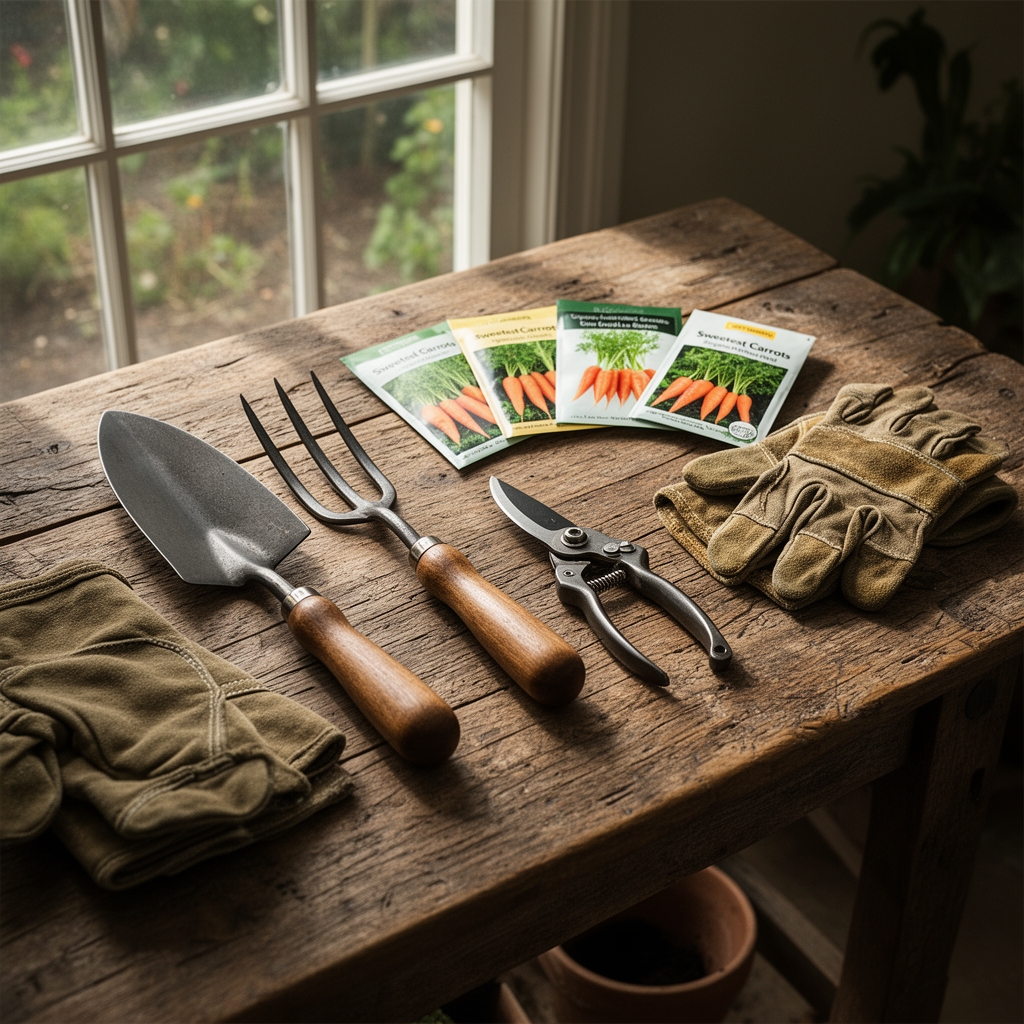
Fertilizer choice governs sweetness trajectory. Apply a balanced 4-4-4 organic meal (feather meal, bone meal, kelp) at bed preparation, delivering 2 pounds per 100 square feet. Avoid high-nitrogen blends (10-5-5 or greater) that redirect photosynthate into foliage rather than root sugars. Supplement with rock phosphate (0-3-0) to support lateral root suppression and primary taproot elongation. Granular sulfur (90% elemental) adjusts alkaline soils downward by 0.5 pH per pound per 100 square feet, activating over 8–12 weeks through microbial oxidation.
Source untreated seed varieties bred for sugar concentration: 'Bolero' F1 (up to 13% Brix), 'Napoli' (early maturity with 10–11% sucrose), or open-pollinated 'Danvers 126' for clay-tolerant sweetness. Each packet requires mycorrhizal inoculant (Glomus intraradices species) at 1 teaspoon per 10 row-feet, colonizing root cortex within 14 days to increase phosphorus uptake efficiency by 300%.
Timing
Sow carrots when soil temperature stabilizes at 45–75°F. Zone 3–5 gardeners target April 15–May 30 for spring crops and July 1–August 1 for fall harvests that mature into frosts. Zones 6–7 extend windows to March 20–June 10 and August 1–September 15. Zones 8–10 favor October through February sowings, as temperatures exceeding 85°F trigger lignification and terpene compounds that code as bitterness.
Fall-maturing carrots synthesize 18–22% more sucrose than spring counterparts. As soil temperature drops below 50°F, carrot roots convert starch reserves into soluble sugars as freeze protection. Time final harvest 2–3 weeks after first 28°F frost for maximum sweetness, monitoring forecasts to avoid hard freezes below 20°F that rupture cell walls.
Phases

Sowing (Day 0–21): Direct-sow seeds 1/4 inch deep in rows spaced 12 inches apart, targeting 3 seeds per inch. Firm soil with a board to ensure seed-to-soil contact necessary for imbibition. Maintain consistent 60–65% moisture in the top 2 inches using shade cloth (30% density) to slow evaporation. Germination occurs in 10–21 days, inversely correlated with soil temperature.
Pro-Tip: Mix radish seeds (1:10 ratio) as living markers. Radishes germinate in 4 days, delineating rows for precise weeding before carrot emergence.
Thinning (Day 21–35): Thin seedlings to 2-inch spacing when true leaves appear, using scissors to avoid root disturbance. Crowding reduces individual root diameter and concentrates auxin distribution into multiple competing apical meristems, producing forked, fibrous carrots.
Pro-Tip: Apply liquid kelp (0-0-1 diluted to 1 tablespoon per gallon) immediately post-thinning. Cytokinins in kelp extract accelerate lateral root senescence, channeling energy into single taproot expansion.
Establishing (Day 35–Harvest): Roots descend 1/4 inch daily under optimal moisture. Side-dress with compost tea (1:10 dilution, brewed 24 hours) every 14 days until day 50, then cease nitrogen entirely. Late-season nitrogen prolongs vegetative growth, delaying the sucrose accumulation phase triggered by nutrient scarcity signals.
Pro-Tip: Expose the top 1/2 inch of carrot shoulders to sunlight during final 10 days. Chlorophyll development in crown tissue synthesizes additional photosynthate without triggering bitterness, adding 0.5–1% Brix.
Troubleshooting
Symptom: Forked or twisted roots with hairy lateral growth.
Solution: Compaction or fresh manure introduced excess nitrogen. Rebuild beds with sand amendment and use only fully composted organic matter aged 12+ months.
Symptom: Cracked, split shoulders.
Solution: Irregular moisture cycling. Fluctuations between drought and saturation cause rapid cell expansion. Install drip irrigation on timers delivering 0.5 inches every 3 days.
Symptom: Pale, elongated roots with low sweetness.
Solution: Excess nitrogen late in development. Test soil nitrate levels (20–40 ppm ideal at day 50). Flush with 2 inches of water to leach excess, then withhold fertilizer.
Symptom: Surface lesions, black rot at crown.
Solution: Carrot rust fly (Psila rosae) larvae tunneling. Apply floating row covers at sowing, burying edges 6 inches. Adults emerge in two waves: late May and mid-August.
Symptom: Bitter, terpene-heavy flavor.
Solution: Heat stress above 80°F or harvest before physiological maturity (90–120 days depending on variety). Mulch with 2 inches of straw to reduce root-zone temperature by 8–12°F.
Maintenance
Water delivers 1 inch per week (measure with rain gauge), split into two 0.5-inch sessions to maintain even 60% moisture at 6-inch depth. Sandy soils require 0.75 inches every 4 days. Cease irrigation 5 days pre-harvest to concentrate sugars through mild osmotic stress.
Weed by hand within the 3-inch root zone to avoid mechanical damage. Mulch application post-thinning (day 35) suppresses competition and moderates temperature swings. Remove any flowering scapes immediately; bolting redirects 40% of root carbohydrates into seed production.
FAQ
Can I grow sweet carrots in clay soil?
Amend clay with 50% coarse sand and 25% compost to achieve friable tilth. Raised beds 12 inches deep bypass native hardpan entirely.
Why are my carrots still bitter after frost?
Varieties differ in starch-to-sugar conversion rates. 'Napoli' and 'Bolero' respond within 7 days of frost; heirlooms may require 21 days below 45°F.
Do carrots need fertilizer after thinning?
Low-nitrogen compost tea (NPK 1-1-1) supports growth through day 50. After that, nutrient restriction signals the plant to store sugars rather than synthesize proteins.
How deep should carrot beds be?
Match depth to variety: Nantes types require 8 inches, Imperator and Chantenay demand 12 inches for straight roots. Shallow beds force lateral branching.
When is peak sweetness?
Fall carrots harvested 14–21 days after first 28°F frost measure highest Brix. Spring carrots peak at physiological maturity (days-to-harvest on seed packet) plus 7 days.