6 Easy Ways How to Grow Juicy Peaches
Biting into a sun-warmed peach that splits under your thumb and drips down your wrist is the reward for mastering how to grow juicy peaches. That sweetness comes from precise soil chemistry, deliberate pruning cuts, and timing your interventions to the tree's auxin cycles. Stone fruit cultivation demands attention to fungal partnerships, calcium availability, and the chill-hour requirements that separate mediocre crops from exceptional ones. Learning how to grow juicy peaches begins with understanding that the tree is a perennial investment responding to every decision you make in the first three years.
Materials
Peach trees (Prunus persica) thrive in soil with a pH between 6.0 and 6.8. Test your soil before planting and amend with elemental sulfur if readings exceed 7.0. Alkaline conditions lock up iron and manganese, leading to chlorotic foliage and reduced photosynthetic capacity.
For baseline fertility, apply a 4-4-4 organic fertilizer at planting. This balanced NPK ratio supports root establishment without forcing excessive vegetative growth. In year two, switch to a 5-10-10 formulation to encourage flower bud differentiation and calcium uptake. Calcium prevents split pits and contributes to cell wall integrity in developing fruit.
Mycorrhizal inoculant is non-negotiable. Mix 2 tablespoons of endo-mycorrhizal fungi directly into the planting hole. These symbiotic fungi extend the root surface area by up to 700 percent, improving phosphorus acquisition and drought tolerance.
Source one-year-old bareroot whips from certified nurseries. Avoid potted specimens older than two years; rootbound systems struggle to anchor properly. Select cultivars with chill-hour requirements matching your climate. 'Redhaven' needs 950 hours below 45°F, while 'Florida Prince' requires only 150 hours.
Timing
Plant bareroot peach trees between late January and early March in Zones 6 through 8. The goal is to establish roots before bud break. In Zones 9 and 10, plant between December and February to avoid heat stress during establishment.
Count backward from your average last frost date. Peach flowers tolerate brief dips to 28°F when fully open, but sustained cold at 25°F destroys the crop. Late-blooming cultivars reduce frost risk in marginal climates.
Fertilize six weeks before bud swell. This timing aligns nutrient availability with the spring flush when auxin distribution drives new shoot formation. Avoid nitrogen applications after July 1st; late-season nitrogen delays hardening and reduces cold tolerance.
Prune during dormancy, ideally in late February. Wounds callus faster as sap begins to rise, and disease pressure from Cytospora and bacterial canker remains low.
Phases
Sowing (Planting Bareroot Stock)
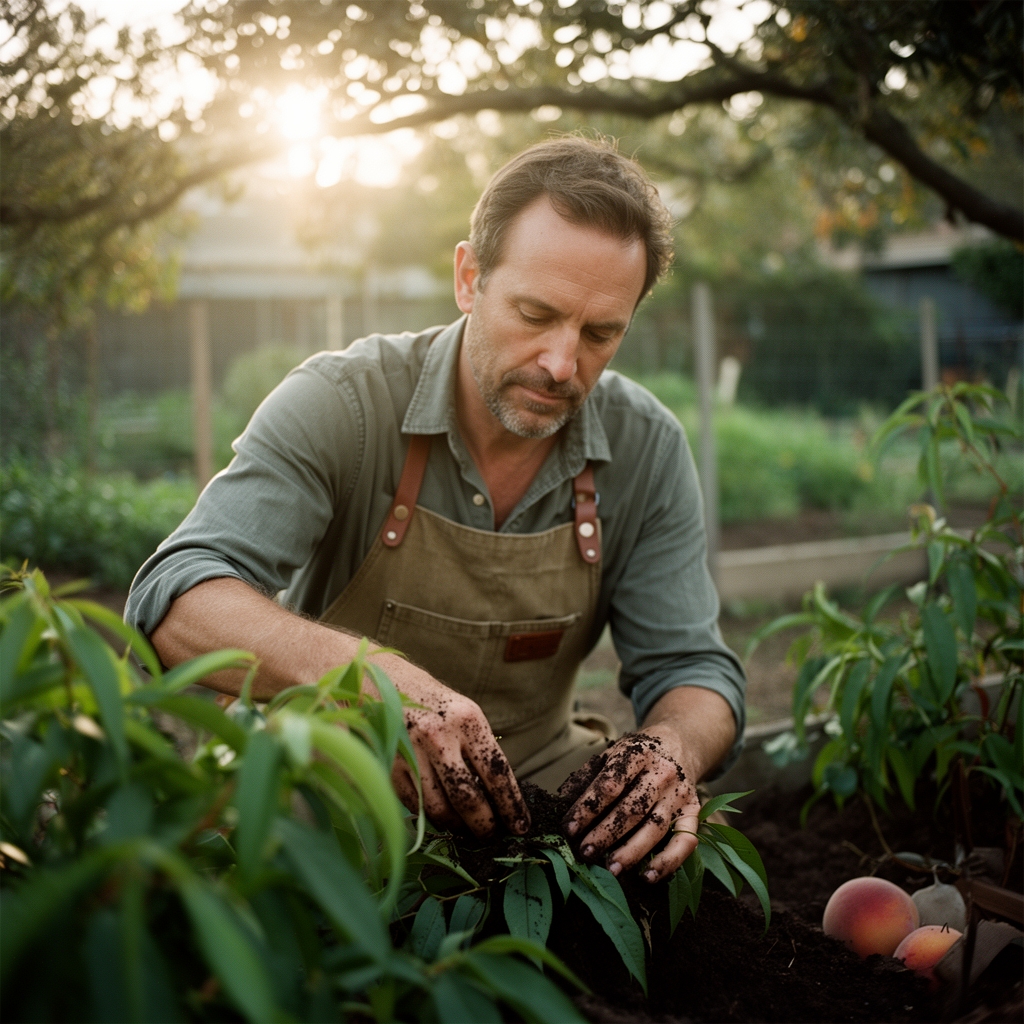
Dig a hole twice the width of the root system but no deeper than the root collar. Peaches resent being planted too deep; the graft union must sit 2 inches above grade. Spread roots radially over a central cone of native soil mixed 1:1 with compost.
Backfill without amendments in clay soils. Organic matter creates a textural boundary that impedes root expansion. In sandy soils with low cation exchange capacity, incorporate 3 inches of aged compost across a 6-foot diameter.
Water with 3 gallons immediately after planting. This settles soil and eliminates air pockets around feeder roots.
Pro-Tip: Prune the whip to 28 inches at planting. This severe heading forces scaffold branch formation at the correct height and prevents the tree from investing energy in fruit during establishment.
Transplanting (Year Two: Training the Open Center)
In late winter of year two, select three to four scaffold branches spaced evenly around the trunk at angles between 45 and 60 degrees. Remove all other growth. Each scaffold should emerge 18 to 24 inches above ground.
Head scaffolds back to 24 inches. This forces secondary branching and builds a sturdy framework capable of supporting 80 to 120 pounds of fruit at maturity.
Apply 0.5 pounds of actual nitrogen per tree in early March. Calculate this by dividing the nitrogen percentage on your fertilizer bag. A 10-5-5 fertilizer requires 5 pounds of product to deliver 0.5 pounds of nitrogen.
Pro-Tip: Paint exposed scaffold bark with white latex paint diluted 1:1 with water. This prevents southwest injury, a form of sunscald that cracks cambium on the south and west sides of young branches.
Establishing (Year Three: Thinning and Fruiting)
Thin fruit to one peach every 6 to 8 inches when fruits reach marble size, typically late April in Zone 7. This spacing allows each fruit to achieve 2.75-inch diameter, the minimum for premium markets. Overcrowded fruit remains small, and excess weight snaps scaffolds.
Monitor leaf nitrogen levels. Mid-shoot leaves should measure 2.8 to 3.2 percent nitrogen on a dry-weight basis in July. Below 2.5 percent, foliage yellows and fruit sugars decline. Above 3.5 percent, vegetative growth outcompetes fruiting.
Pro-Tip: Foliar spray with kelp extract (0-0-1) plus soluble calcium at petal fall and again three weeks later. This combination reduces peach scab and supplies calcium directly to developing fruitlets when root uptake lags.
Troubleshooting
Symptom: Split pits with gummy cavities in the flesh.
Solution: Insufficient calcium or drought stress during pit hardening (four to six weeks after bloom). Maintain consistent soil moisture at 1 inch per week and apply gypsum at 2 pounds per tree in early April.
Symptom: Curled, reddened leaves with blistered appearance in spring.
Solution: Peach leaf curl (Taphrina deformans). Spray fixed copper (2 tablespoons per gallon) at 90-percent leaf fall in autumn and again at bud swell before pink tissue shows. Fungicides are ineffective after infection appears.
Symptom: Brown rot on ripening fruit, starting as small tan spots that expand rapidly.
Solution: Monilinia fructicola thrives in humid conditions. Remove mummified fruit from previous seasons. Apply sulfur dust (90% wettable) every 10 days from shuck split through two weeks before harvest.
Symptom: Holes in fruit with frass (sawdust-like excrement) near the stem.
Solution: Oriental fruit moth larvae. Pheromone traps detect adult flights. Spray spinosad (organic) when trap counts exceed five moths per week, targeting shuck split and cover sprays at 10-day intervals.
Symptom: Yellow foliage with green veins, primarily on new growth.
Solution: Iron chlorosis in alkaline soils. Chelated iron (FeEDDHA) applied as a soil drench at 1 ounce per inch of trunk diameter corrects deficiency. Long-term solution requires lowering pH with sulfur.
Maintenance
Water deeply once per week, delivering 1 inch measured with a rain gauge. Drip irrigation maintains consistent moisture without wetting foliage, reducing disease pressure. Peaches need 36 inches of water annually, with peak demand from pit hardening through harvest.
Mulch with 3 inches of wood chips in a 4-foot radius, keeping material 6 inches away from the trunk. Mulch moderates soil temperature, suppresses weeds, and feeds soil microbes that improve aggregation.
Prune annually in late winter. Remove 40 percent of the previous season's growth to maintain an open center. Cut shoots back to outward-facing buds to encourage horizontal branching. Fruiting wood on peaches is productive for only two to three years; renewal pruning replaces exhausted wood.
Apply 0.1 pounds of actual nitrogen per inch of trunk diameter each March. Measure diameter at 12 inches above the graft. A 3-inch trunk requires 0.3 pounds of nitrogen, equivalent to 3 pounds of 10-10-10 fertilizer.
Scout weekly for pests and disease from bloom through harvest. Early detection of plum curculio, thrips, or bacterial spot allows targeted intervention before populations explode.
FAQ
How long until a peach tree produces fruit?
Standard trees bear in year three. Genetic dwarf cultivars on 'Lovell' rootstock may fruit lightly in year two but reach full production by year four.
Can I grow peaches in containers?
Yes. Choose genetic dwarfs like 'Bonanza' or 'Pix Zee' in 20-gallon pots with drainage holes. Use a soilless mix with perlite for aeration. Container trees require daily watering in summer and winter protection in Zone 6 and colder.
Why do my peaches lack flavor?
Harvest timing is critical. Peaches develop sugars only on the tree. Pick when the background color shifts from green to cream and fruit separates easily with a gentle twist. Refrigeration halts sugar development.
Do peach trees need a pollinator?
Most cultivars are self-fertile, but planting two varieties increases fruit set by 15 to 20 percent through better pollen transfer and extended bloom overlap.
How do I protect blossoms from late frost?
String incandescent lights (not LEDs) through the canopy and turn them on when temperatures approach 28°F. Micro-sprinklers that coat flowers with ice also work; latent heat from freezing water protects tissues down to 25°F.